
How Following a Structured Strength & Conditioning Plan Streamlines Rugby Performance
Rugby performance is built long before match day.
Strength and conditioning (S&C) provides the physical foundation that allows players to perform
repeated high-intensity actions, stay resilient to injury, and meet the increasing demands of modern
rugby. When delivered through a structured plan, S&C turns training into measurable, long-term
performance outcomes.
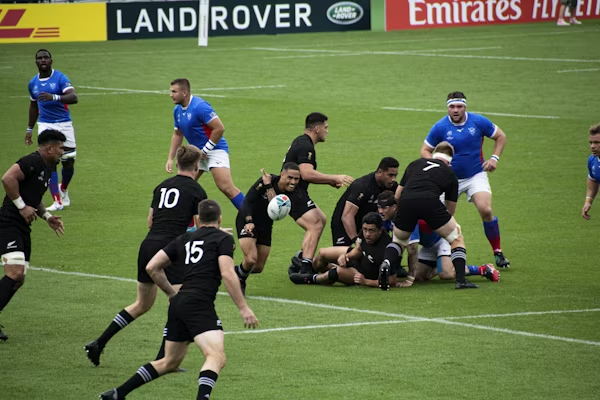
Why Strength & Conditioning Is Essential for Rugby Performance
– And How Following a Structured Plan Streamlines Performance Goals
Rugby is a high-intensity collision sport that places significant physical demands on players across all
positions. Strength and conditioning is therefore a fundamental component of performance,
particularly as playing standards increase.
Effective S&C improves strength, power, speed, and endurance — all of which directly influence a
player’s ability to perform repeated high-intensity actions such as tackling, accelerating, carrying into
contact, and scrummaging.
Interesting Fact: Why Injury Reduction Matters
One of the most important roles of S&C is injury reduction. Players who are physically prepared for
the demands of training and competition are less likely to suffer injuries, particularly when training
loads are progressed in a structured and controlled manner. Research by Gabbett (2016) highlights
that appropriate load management is essential in reducing injury risk in collision sports such as
rugby.
Why a Plan?
The benefits of strength and conditioning are maximised when players follow a structured plan.
Training without direction often leads to inconsistency, unnecessary fatigue, or performance
plateaus. A well-designed programme aligns physical training with performance goals, competition
demands, and recovery needs.
For Example:
– A Winger aiming to improve acceleration will benefit from a plan prioritising sprint
mechanics, lower-body power, and plyometric training rather than nonspecific gym sessions.
– Similarly, a Forward targeting improved contact performance should prioritise maximal
strength to improve dominance in tackles and carries, alongside power training to win the
initial collision and generate post-contact metres.
The Positive Impact
Following a structured plan ensures training is purposeful, progressive, and measurable. It allows
players to track improvements, manage training load and fatigue, and maximise training efficiency.
Over time, this supports long-term physical development rather than short-term performance
spikes.
Conclusion
In modern rugby, strength and conditioning provides the physical foundation for performance.
When supported by a structured training plan, S&C streamlines performance goals, reduces injury
risk, and enables players to perform consistently at higher levels.
Reference: